Funding for schools and educational infrastructure
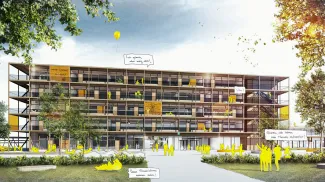
In Nuremberg, Helaba is financing the construction of the new Martin-Behaim-Gymnasium, which will accommodate around 1,500 pupils, in partnership with Sparkasse Nürnberg. As lead arranger, the Landesbank has structured a loan of around 175 million euros as part of a public-public partnership with WBG Kommunal GmbH, the city’s housing association. The project contributes to Helaba’s long-term commitment.
1,500
Pupils will attend the Martin-Behaim-Gymnasium once the new building is completed
Helaba and Sparkasse, in partnership with WBG Kommunal GmbH, are financingNew school building in Nuremberg
The plans look impressive: an open-plan school building constructed from timber, a modern canteen, a huge sports hall with seven pitches, and green outdoor spaces through which a restored stream meanders. The Martin-Behaim-Gymnasium in south-east Nuremberg has everything it needs to be a sustainable venue for up to 1,500 pupils and 160 teachers once the new building is completed in 2026. The low-energy building will be equipped, amongst other things, with a photovoltaic system and geothermal energy, which will provide electricity – and, depending on the season – heating or cooling. Furthermore, the design prioritises sustainability in the construction process: the contractors are using recycled concrete made from materials from the old building.
Helaba and Sparkasse Nürnberg are financing the project. The lending process differs from that used, for example, for larger infrastructure projects or for businesses. The approximately 175 million euros are being raised as part of a public-public partnership with WBG Kommunal GmbH, the city’s housing association. This type of collaboration offers significant advantages for all parties involved.
We can finance the project at favourable interest rates and with long maturities because, in the case of a public body, we can rely on its creditworthiness.
Thomas Ostermann
Deputy Head of the Project Finance Department
Special credit protection
“We can finance the project at favourable interest rates and with long maturities because, when dealing with a public body, we can rely on its creditworthiness – in this case, that of the City of Nuremberg,” says Thomas Ostermann. The deputy head of the Project Finance department at Helaba structured the loan. He explains that there is a high degree of certainty that the loan will be repaid – and this makes favourable financing terms possible. Even if, in an extreme scenario, the city were no longer able to make payments, the loan would still not be lost. “Local authorities are protected by a whole range of instruments, such as municipal equalisation schemes or the federal-state financial equalisation scheme,” says Ostermann.
Nevertheless, such a project still involves a great deal of work for the project finance team. Issues to be addressed include, for example, the volume of the loans, the terms and the repayment structure. “We also have to look closely at who is involved in the contracts and check their authorisation to do so,” says Markus Greif, who has increasingly been involved in school financing projects both at home and abroad in recent years. Added to this is the fact that, in the case of local authority contracts, local politics is always involved – for instance, the council of the relevant town, which approved the project in the past. “Budgetary law in local authorities is complex,” explains the project financier at Helaba. “To this end, we examine the administrative documents produced during the process and check, for example, whether certain maximum limits for construction costs were approved.” At a time when the cost of building materials has risen sharply – by 8.8 per cent in 2021 and 16.8 per cent in 2022 – this is a key test.
Public-private partnerships abroad
Such a project becomes even more extensive when it is carried out abroad. Helaba provides funding for schools in countries such as Austria, England and Ireland. The financing structure there differs from that in Germany because there are many public-private partnerships, particularly in the education sector. This involves close partnerships between public contracting authorities and private contractors. These contractors not only build the school, but also retain ownership of it and run it, for example by providing caretaker services or carrying out maintenance. In return, they receive rent from the local authority. “For these models, we work with our overseas offices or with local lawyers to ensure that the projects comply with applicable law,” explains Markus Greif.
Working in a spirit of trust with local authorities and federal states is very important in Germany.
Markus Greif
Deputy Director of Project Finance
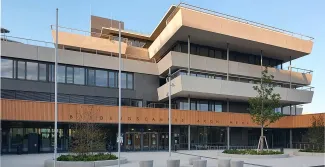 Bildungscampus Aron Mencer in Wien
For Markus Greif, working in a spirit of trust with local authorities or the federal states in Germany is very important, particularly when there have been several projects with the same clients over the years. He and his colleagues are then familiar with the contractual structures and can therefore work very efficiently. Nevertheless, according to Greif, Germany’s federal system means that there are always new nuances to projects. Things are simpler in the Netherlands, where Helaba has already co-financed a number of public-private partnerships. “There, for example, there is a separate authority for transport infrastructure – which builds roads, locks or tunnels – and another for public building construction – and they have standard contracts that simply need to be adapted.” This makes the work easier and also ensures greater efficiency.
Focus on sustainability
For Helaba, the financing of schools is a key component, particularly in the context of its sustainability-oriented business activities. For the Landesbank, this has both an environmental and a social dimension. “Schools are a particular focus for us in this regard, as they play an important role in the social sphere,” says Petra Sandner, Chief Sustainability Officer of the Helaba Group. “When considering new transactions and financing arrangements, we regularly assess whether they contribute to one of the United Nations’ 17 Sustainable Development Goals.” One of these, Goal 4, is ‘Quality Education’, to which functional and modern buildings also contribute. “The modernisation of educational infrastructure is urgently needed across the board,” says Petra Sandner. At the same time, she adds, the long-term improvement of educational quality in urban areas is particularly important for creating a stable and sustainable society.
We place particular emphasis on schools, as they play an important role in the social sphere.
Petra Sander
Chief Sustainability Officer of the Helaba Group
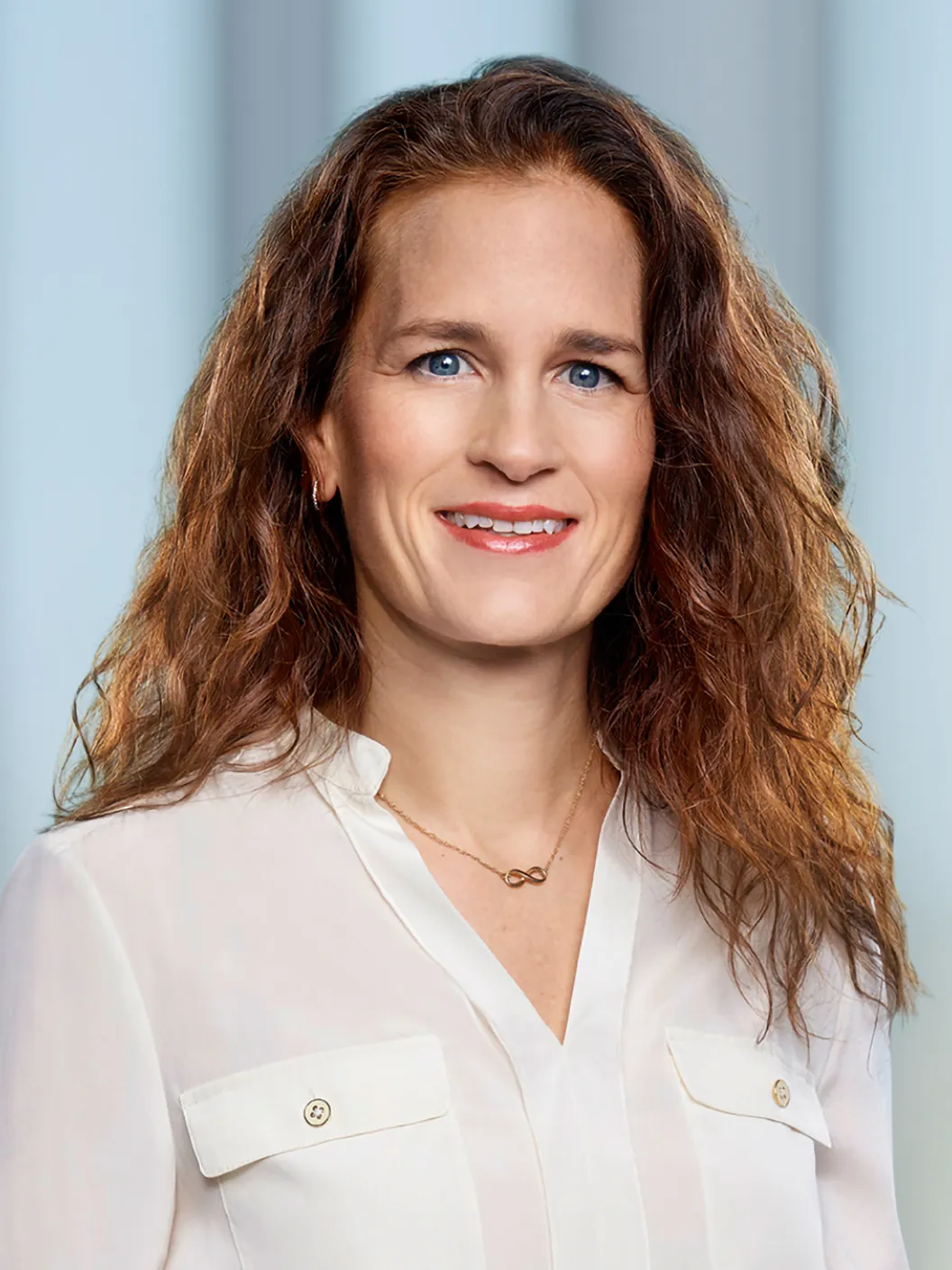
The subject of schools is also close to Markus Greif’s heart; he completed his apprenticeship at a savings bank and has been working at Helaba for 15 years. “Educational institutions are by no means abstract, but very concrete – and they certainly fulfil an important purpose,” says Markus Greif. Whether he is travelling for work or on holiday, he likes to visit the projects he has helped to finance whenever he is in the vicinity. “For example, I once went to see the Campus+ model in Vienna, which I’d previously only known from animated images or architectural drawings,” he recalls. “It was truly impressive to see the pupils and teachers walking in there. A set of contracts has been transformed into a real place of learning.”