A partner for Poland’s offshore boom
The construction of the Baltyk 2 and 3 offshore wind farms marks a turning point for Poland’s energy supply – fully in line with the European Green Deal. The successful financing of the project demonstrates why leading developers and operators worldwide rely on Helaba.
40
Offshore wind farm projects
which Helaba has already supported internationally
Significance for Poland
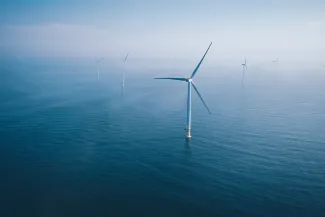
The year 2025 was a significant one for Poland’s energy policy. In May, the financing for one of the country’s largest wind energy projects was finalised. The Baltyk 2 and 3 wind farms are being built along the Baltic Sea coast near Ustka and Łeba, with a planned total capacity of up to 1.44 gigawatts.
From 2028, renewable electricity will flow from the sea to the mainland, powering millions of Polish households. Poland is thus taking on an important role as an additional pillar of sustainable energy supply in Europe. The European Green Deal aims for climate neutrality by 2050 and supports projects such as Baltyk 2 and 3.
1.44
Gigawatts
of total power are generated by the wind farms
100
Wind turbines
will be built by 2028
2 million
Households
can be supplied with electricity
6 billion
Euro
is the total loan volume
28
Banks
make up the financing consortium
2
Client:
Equinor and Polenergia
Helaba is the Mandated Lead Arranger for the project
A construction project of this scale requires bespoke financing. At more than 6 billion euros, this is the largest bundled project finance transaction in Poland’s history – a sum provided by a consortium of 28 banks. Helaba, together with the other Mandated Lead Arrangers (MLA), took on the task of arranging the necessary loan, including all analyses and management tasks.
“We analyse the various external reports and provide feedback on them in an interactive process, continually incorporating our own perspective,” says Stefan Seibel, team leader of the Renewable Energies department at Helaba, describing the approach. At the same time, Helaba is one of the five largest lenders in the deal, which is fully aligned with the bank’s sustainability strategy.
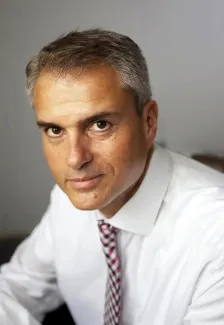
Stefan Seibel,
Team Head of Renewable Energy, Project Finance is a qualified engineer who discovered his passion for energy at an early age.
Twenty-five years ago, whilst working as an international technical adviser on the project financing of a power station, he became acquainted with Helaba and decided to make the move.
He has now been leading the Renewable Energy team for over 15 years. His professional background helps him, in particular, to understand and assess the technical risks of a project more easily.
Clients with a global presence rely on Helaba
This major project is being implemented by Equinor, a world-leading developer and operator of offshore wind power, and Polenergia, Poland’s largest private energy supplier. Together, they are pooling their expertise in renewable energy projects and their regional knowledge to drive forward the transformation of the Polish energy sector.
“When we are able to arrange such complex financing deals with the biggest players in the market, we create an outstanding track record in the market each time,” says Seibel. Helaba can now point to more than 40 offshore projects in countries including the USA, France, the UK, the Benelux countries and, of course, Germany.
When we take on a project, we know what is required. The sponsors can rely on that. The team is very familiar with the structural and technical risks.
Stefan Seibel
Team Head, Renewable Energy, Project Finance
Helaba stands out for its experience, expertise and reliability
Helaba already has a track record of success in Poland: It entered the market in 2023 with Northland Power, a long-standing Helaba client, on the “Baltic Power” wind farm, which Helaba also supported as MLA. “We are commissioned for these major projects because we have proven ourselves time and again in the field of offshore wind farms.
Expertise and reliability are major assets in the project business,” says Stefan Seibel, who has been managing renewable energy projects for more than two decades. Should Poland press ahead with its renewable energy initiatives, this success story could, according to Seibel, enter a new chapter: “Helaba has firmly established itself as a key partner amongst all the major players, both in Poland and across Europe.”
So arrangiert die Helaba Großprojekte
Benefits for operators
This approach enables large amounts of financing to be secured and facilitates the involvement of international banks. The sharing of risk ensures greater stability and confidence in the syndication process, as well as favourable lending terms for the operators.
How does syndication work?
Syndication for an offshore wind farm means that several banks (MLAs or underwriters) jointly underwrite a loan to the project developer. Once the transaction has been finalised, the MLAs may resell parts of the loans. This allows very large investments to be financed and risks to be spread.
For the majority of Helaba’s more than 40 offshore wind projects, the loans were financed in this way by a large banking consortium.