Green promissory note loans with the City of Offenbach
The city of Offenbach is breaking new ground in the financing of new schools, nurseries and climate protection measures. Together with Helaba, it has placed green promissory note loans on the market. This model, which has rarely been used to date, could be of interest to many local authorities. After all, it combines benefits for issuers and investors in a sustainable, all-round package
Advantages of green promissory note loans
Offenbach: A City Worth Living In
What makes a city worth living in? The answer to this question changes over time and can vary greatly from person to person. Yet there are common threads. Virtually all major city rankings come to the same conclusion: if urban areas are safe, green and have sufficient school and nursery places, people feel at home. Good internet connectivity and a well-developed local transport network further enhance the sense of well-being. But the problem is: all of this costs a lot of money. And that is in short supply.
The investment backlog is growing in German local authorities. Around 186 billion is needed for infrastructure, digitalisation, healthcare and education, according to figures compiled by the German Association of Towns and Municipalities. There is a particular shortage of new schools, nurseries and roads. Added to this is the fact that funding is also needed for climate protection and adaptation to climate change, in order to make cities more liveable in the future.
In Offenbach, too, the list of important construction projects is long. The Hessian town has been growing steadily for years. By early 2025, the population will stand at 132,096. “That’s encouraging, but it means we have a responsibility to create new school and nursery places for the younger generations,” says Martin Wilhelm. As the city’s treasurer, he faces the challenge of securing funding for these important projects despite tight budgets: “With traditional municipal loans, you eventually reach your limits,” he explains.
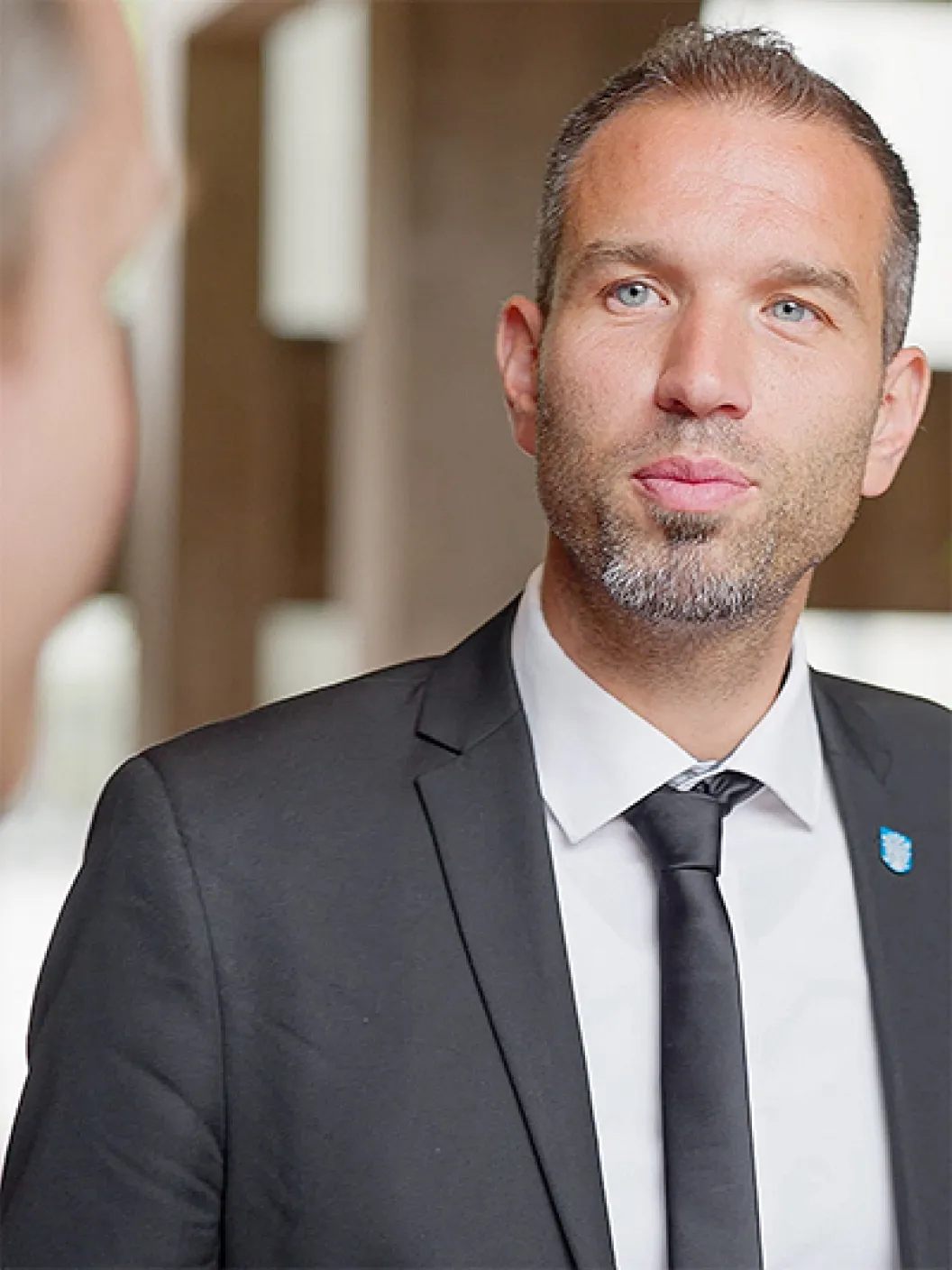
A process like this is challenging for us as a city, but all in all it went very well. This was also down to the fact that, in Helaba, we had a partner who simply understands local authorities.
Martin Wilhelm
Treasurer of the City of Offenbach am Main
Seeking – and finding – partnership-based financing
Martin Wilhelm was all the more open-minded when, just over two years ago, his head of department, Markus Riedl, proposed a forward-thinking solution: Green promissory note loans, the sort previously issued only by significantly larger local authorities such as Munich, Hanover, Cologne and Münster. Projects to be financed must meet market-standard ESG (Environmental, Social and Governance) criteria. For the city of Offenbach, the scheme offers decisive advantages: “We are tapping into new groups of investors that we cannot reach with a traditional municipal loan. This enables us to significantly diversify our creditor base,” says Markus Riedl. The background to this is the increased demand from major investors for long-term, sustainability-focused investments. However, turning the idea into a marketable package requires a financial partner.
This naturally leads to Helaba, which regards the promotion of sustainable infrastructure as one of its core tasks and therefore already has extensive experience in structuring sustainable financial instruments. The two parties have been collaborating on numerous projects since 1982. This time, the bank is taking the lead as the sole lead arranger – that is, as the structuring and coordinating bank which acts as the interface between the issuer and investors throughout the entire life cycle of the promissory note loans. Rainer Neidnig is part of the team. As Head of Sustainable Finance Advisory at Helaba, he has already supported numerous sustainable financing deals for local authorities or municipal companies on several occasions and sees the green promissory note as the most sensible way to invest in the future of the people of Offenbach: “Here, ecology and economy really do go hand in hand. Investors are interested in sustainable investments, whilst the city can drive forward capital-intensive projects and improve the quality of life.”
We are tapping into new groups of investors whom we cannot reach through a traditional municipal loan.
Markus Riedl
Head of the Finance, Cashier’s Office and Tax Department, City of Offenbach am Main

136.5
millions of euros is the amount of the promissory note.
The market is there
And it is with this synergy that Martin Wilhelm’s team is winning over the market, as the closing demonstrates. Placed on the capital market in January 2025, the €136.5 million promissory note was already oversubscribed after just a few days, “several weeks before the deadline”, explains Wilhelm. Investors include, in particular, insurance companies, development banks and pension funds. Repayments are due after ten, 15 and 30 years, which meets the city’s desire for the longest possible maturities and offers investors planning certainty.
To clearly set out what the money will be used for and how, the city is developing a so-called Green Finance Framework with the help of Helaba. This sets out what is being funded, how and why. “It is based on the generally recognised market standards of the Green Bond Principles of the International Capital Market Association (ICMA) and the Green Loan Principles of the Loan Market Association (LMA),” says Rainer Neidnig. This framework was reviewed by an independent third party – in this case, the Europe-wide credit rating and sustainability agency EthiFinance – as part of a so-called Second Party Opinion, which confirmed full compliance with the relevant market standards.
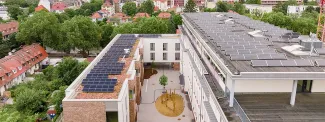 Die neue Grundschule der IGS Lindenfeld verbraucht 60 Prozent weniger Energie als gesetzlich vorgegeben.
Space for modern concepts
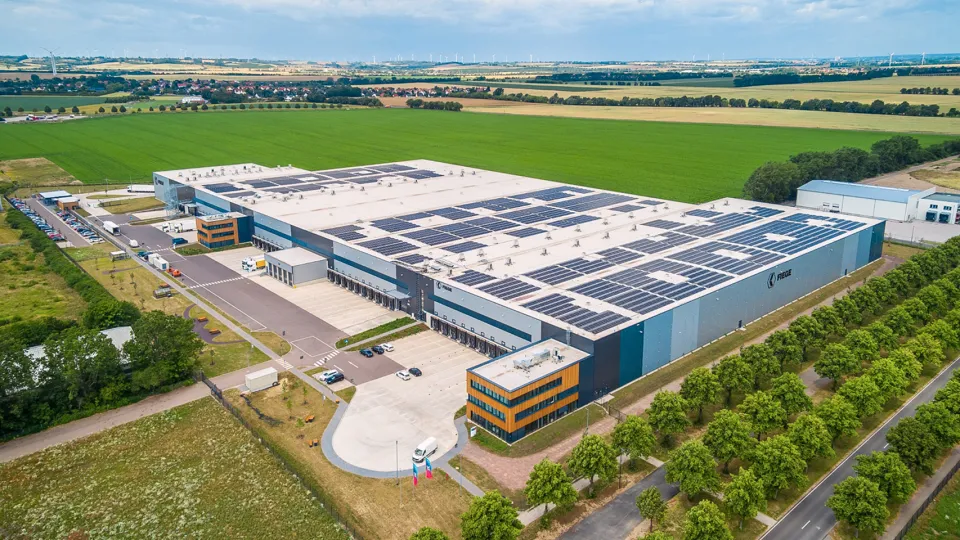
The framework sets out, in particular, criteria for the use of funds and the selection of suitable investments in energy-efficient buildings, as well as measures to adapt to climate change. In addition to the upgrading and extension of the Main dyke, the focus is primarily on schools and nurseries that are either planned or currently under construction. For Anna Heep, the city’s Head of Building Construction Management, this is an indication that the strategy pursued in the past was the right one. “Our construction projects fully met the criteria for the promissory note without us having to make any adjustments. We are therefore pleased that we planned with such a forward-looking approach.” Since 2007, the focus has been on modern educational buildings; a climate strategy with a net-zero target by 2045 has been in place since 2020. All buildings are therefore designed in accordance with EU energy efficiency standards. Since 2022, the town has been a member of the German Sustainable Building Council (DGNB e.V.) and is developing its expertise in the field of sustainable construction. The new buildings usually exceed the requirements by a significant margin. For example, the new primary school at IGS Lindenfeld consumes 60 per cent less energy than required by law.
The pupils also benefit from this, as Anna Heep knows. Among other things, the architect is an expert in educational architecture: “Most schools are designed using what is known as a cluster layout.” This concept expands on the traditional layout – with long corridors and classrooms branching off – to create a more open, collaborative environment. “This encourages interaction, whilst also offering the option to break into smaller groups for modern teaching approaches.”
In the past, we have already planned our selected construction projects in such a way that they have met all the criteria for green bonds.
Anna Heep
Head of the Municipal Building Management Department in Offenbach am Main
New approaches to achieving the green goal
The clear advantages of the green financial instrument nevertheless entail additional administrative work. For example, all documents and information for the investor group must be collated, and the payments that Helaba, as the paying agent, makes available to investors must be managed over the years. Offenbach is therefore breaking new ground in this area too, bringing everything together under GEO – the Offenbach Green Municipal Enterprise. Thanks to a streamlined structure, experts from the fields of construction and finance are brought together within a trust-based organisation operating under the city’s umbrella. This speeds up decision-making whilst still offering investors all the necessary safeguards in the financing of public projects. Martin Wilhelm says: “A process like this is challenging for us as a city, but all in all, setting up GEO has worked very well. This was also down to the fact that, in Helaba, we had a partner who simply understands local authorities.”
With its bold move into the sustainable capital market, the city of Offenbach has demonstrated how a local authority can create scope for important investments. Or, as Treasurer Martin Wilhelm puts it: “The effort has paid off for the whole city.”
Here, ecology and economy really do go hand in hand. Investors are keen on sustainable investment, whilst the city can drive forward capital-intensive projects and improve the quality of life.
Rainer Neidnig
Head of Sustainable Finance Advisory, Helaba
Public Sector
The Public Sector division supports infrastructure projects undertaken by the federal government, the federal states and local authorities.
Find out more