
Positive Scenario: the golden formula
Against the background of low expectations on all sides, a pleasant surprise in 2027 should be easy to achieve. But if we talk about a positive scenario, it quickly becomes clear how high the demands on the laboratory staff really are: carefully selected reactants and catalysts in exactly the right dosage plus the right amount of energy, otherwise there will not be a gold nugget. What remains is a lump of ordinary lead.

But difficult does not mean impossible. Many of the ingredients are neither rare nor particularly precious. In some cases, even the absence of individual factors may be sufficient. In our positive scenario, there will be no new geopolitical shocks in 2027. Adaptation and habituation processes will push the burdens of existing trouble spots into the background. Perhaps the situation will even ease at one point or another.
However, less uncertainty and political disruption are only part of the "2027 formula for success". For example, the impetus of AI for the global economy in the form of additional investment demand, multiplier effects and rising stock market wealth is stronger than currently expected. A broader application of the new technology can also unleash entrepreneurial forces in sectors that have so far benefited little from AI.
In addition, under the impression of disappointments in the recent past, our baseline scenario could underestimate the industrial cycle. The WTO's forecasts for world trade in the following year have always been too cautious in recent years. Just as self-reinforcing recessionary forces can be set in motion in the negative scenario, such dynamic processes are also possible in an upswing. Economists call this seemingly magical/alchemical process "multiple equilibria": once the economy has escaped the rut of weak growth, it suddenly performs sustainably better – without any additional energy supply in the form of stimulus measures.
Countries benefit to varying degrees from the industrial upswing
Share of manufacturing in GDP, %*
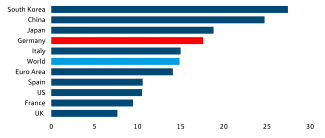 *2025 or last available version, Sources: LSEG, Helaba Research
Geopolitical conflicts as an opportunity
Politically, crises always bring not only risks, but also opportunities. The EU and the governments of the member states, if they act cleverly, could use the geopolitical environment to present themselves to third countries as a trustworthy and reliable partner that pursues economic and not primarily power-political goals – in contrast to the US and China. This could open up new markets, diversify supply chains and maintain the rules-based world trade regime at least within a "coalition of the willing".
Eureka!
Archimedes of Syracuse
Domestically, stronger economic growth defuses distributional conflicts and takes the wind out of the sails of the populists. In addition, tax revenues are rising, which expands the governments' political room for manoeuvre. Mostly economically motivated resistance to decarbonisation fades.
Forecast overview for the positive scenario
The global economy is picking up. The industrial cycle is surprising on the upside, and trade in goods is growing even stronger. Substantial investment, especially in AI, as well as structural reforms also improve growth prospects in the medium term. Due to the high share of manufacturing in Germany, the global industrial upswing is giving a particularly strong boost to the economy here. Production increases significantly and unemployment falls with a slight delay, which in turn stimulates demand. German gross domestic product will increase by more than 2 % in 2027. The euro zone will also grow strongly at over 2 %. The US economy will even achieve growth of around 3 %.
In this scenario, stronger productivity growth as well as inflation-dampening effects of geopolitical easing and more efficient supply chains reduce price pressures. Nevertheless, strong demand is pushing inflation somewhat higher. Inflation rates are therefore not approaching the central banks' targets. In Germany and the euro zone, the inflation rate will rise above the 3 % mark on average in 2027.
Stronger trend growth means that the "neutral" interest rate level is also higher. Central banks increase the degree of restrictiveness of monetary policy in 2027. In contrast to the baseline scenario, the ECB and the Fed will raise key interest rates slightly in 2027.
There are price losses on the bond market. In the wake of slightly rising inflation and further key interest rate hikes, the yield on 10-year US Treasuries climbs above 5 %, while that of 10-year Bunds climbs over 4 %. Although yield curves are steepening, this effect is limited as strong economic growth casts the debt situation of the countries in a milder light.
Equities are benefiting both from the strengthening global industrial cycle and from productivity gains driven by the broader adoption of artificial intelligence. Corporate profits are growing at a double-digit rate. In view of the positive earnings development, investors continue to tolerate elevated valuation levels, allowing equity markets to deliver above-average returns. We forecast the DAX to reach 32,000 points by year-end.
Strong economic growth is boosting German real estate. The increase in purchasing power is more than offsetting the effect of slightly higher financing costs, causing residential real estate prices to rise. Demand for retail and office space is also picking up in the positive economic environment, therefore helping transactions and prices to increase.
The increasing risk appetite of investors in combination with declining risk premiums is putting a heavy strain on the safe haven of gold. At the same time, opportunity costs for the interest-free precious metal are rising, so that the price of a troy ounce is falling towards 3,000 US dollars.
The absence of new geopolitical shocks and the favourable global economic development are increasing investors' risk appetite. As a result, demand for the safe haven US dollar is falling, while demand for the euro is rising. In addition, the lower interest rate disadvantage of the euro zone is having a positive effect on the common currency. The euro-dollar exchange rate will rise to 1.25 by the end of the year.

-
-
In the global economy laboratory, the Bunsen burners flicker, geopolitical mists cloud the view, and yet the grand experiment remains remarkably stable.
-
- 20 Negative scenario: laboratory accident
- 70 Baseline scenario: Eager experimentation
- 10 Positive scenario: The golden formula
Probability of the scenarios occurring
Note: All images of the laboratory scenarios have been generated using AI.