
Baseline scenario: Eager Experimentation
There’s no doubt about it – the global economy has seen calmer times. Currently, visibility in the lab is limited, a geopolitical haze is rising from the Erlenmeyer flasks. Confidence in the lab team’s expertise has been shaken. However, the global economy has proven to be unexpectedly resilient for some time now. With the support of the industrial cycle and some luck regarding potential new shocks, “Experiment 2027” is likely to surprise the numerous pessimists in a positive way.

No long brainstorming required: The current list of potential dampeners and disruptive factors for the global economy seems to contain at least as many elements as the periodic table. Despite all these challenges and undeniable problems, we expect 2027 to be a reasonably good year for global growth. The world economy has already weathered unexpected shocks in 2025 (trade conflict) and 2026 (war with Iran), which many saw as serious threats to growth and the financial markets. Even the inflation and key interest rate shock of 2021–2023 did not trigger a recession, as had occurred in previous cycles.
Notably, the hope for a solid cyclical performance is not really based on an optimistic assessment of the “lab technicians”. In 2027, we can again expect to see several unconventional experimental set-ups, particularly in Washington. Although Donald Trump will have to make certain concessions to the new Democratic majority in both houses of Congress following the mid-term elections, he has, in any case, mostly ignored Congress in many key policy areas
since taking office in 2025. He is likely to continue doing so in the second half of his term. He retains considerable leeway in this regard, particularly when it comes to foreign and security policy.
Elections in other key countries, including France, Italy and Poland, may designate some new and inexperienced lab teams. In particular, the French presidential election could send someone into the lab who will first need to familiarise themselves with basic security protocols. However, as in Italy, the responsibilities of the office may ultimately lead to a pragmatic approach-
Global industrial recovery
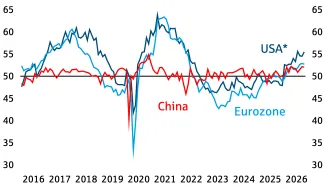
Purchasing Managers' Indices Manufacturing
 *ISM Quellen: Macrobond, Helaba Research
The industrial cycle and global trade as drivers
Even if the key input factors (reactants) for the global economy and financial markets have been successfully identified, it is impossible to predict exactly in what com-
bination and sequence they will come together in a given year, and thus what the consequences will be.
The industrial cycle is set to emerge as a key driver in 2027. After years in which momentum was heavily concentrated in AI-driven sectors, there are signs that the long-
awaited, repeatedly stalled by shocks, broader upturn in global industry is finally on the horizon. Despite its structural problems, Germany's manufacturing- and export-
oriented economy will benefit disproportionately from this.
Another development that does not always receive sufficient attention in the media or among the wider public is helping with this. Some 18 months after Donald Trump’s “Liberation Day”, globalization is faring significantly better than one might have hoped. Global trade is thriving, and this phenomenon is not limited to China’s export performance. So far, all those geopolitical conflicts have not altered the fact that international trade is growing faster than production (see Special, p. 23). Even for the strained relationship between the US and China, the most likely scenario for 2027 appears to be a continuation of the trade “truce”.
Stable burdens
While other factors that have a less than positive effect are also likely to play a role in 2027, we do not look for them to have a significantly greater impact than in 2026. These include the strained state of public finances in many indus trialised countries and in China. Therefore, neither the US nor the EU are planning any economic stimulus pro grammes. However, significant fiscal consolidation measures are also not likely. A lower US deficit would primarily be the result of political deadlock between the President and Congress, rather than of targeted austerity measures. Fol lowing the surge in 2026, we do not expect long-term interest rates to rise further in 2027, which will mitigate addi tional strains caused by increased financing costs.
Only a fool makes no experiments!
Charles Darwin
Then there is the process that economists rather dryly refer to as “technological progress”, yet which is one of the most important drivers of economic development. Currently, this is primarily embod ied by artificial intelligence, the opportunities and risks of which are the subject of heated debate. It is important to distinguish between short-term and long-term consequences. Looking ahead to 2027, the following questions are at the forefront: Will investment in AI continue to increase, or will it reach its peak? Will AI company profits fall short of expectations, or exceed them? And will the political and cultural back lash against the new technology, which is particularly noticeable in the US, continue to gain momentum?
Less inflation – and less state intervention?
Inflation is likely to decline in major industrialised countries in 2027, primarily due to lower energy prices. This will strengthen households’ purchasing power and enable central banks to keep an eye on the growth picture. We antici pate a further modest tightening of monetary policy in 2026. Key interest rates should thus be at the upper limit of the “neutral zone” or slightly in restrictive territory in 2027. We consider current market expectations regarding fur ther interest rate rises by the ECB and the Fed in 2027 to be exaggerated.
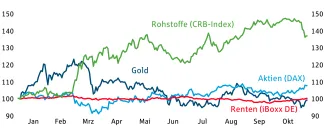
Performance 2026: Commodities in the fast lane
Indexed to 31 December 2025 = 100, total return in euro
 Quellen: LSEG, Helaba Research
In 2027, another key issue will once again be the search for the right balance between state interven tion and private initiative, which is a necessary condition for sustaina ble growth. While the EU has re cently made much of its commit ment to reducing bureaucracy, this has not been matched by action. Meanwhile, a more active industrial policy is steadily increasing the scope for government intervention.
The increased focus on security in the face of ongoing military and hy brid threats is playing into the hands of the state anyway. The cli mate transition will not be achievable as planned without regulatory guidance or additional public investment. In Ger many, the reform process, which could strike a better balance between private initiative and the state, as well as un leashing additional growth potential, is stalling.
Overview of forecasts in the baseline scenario
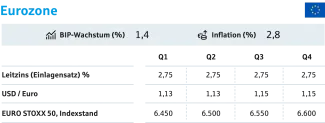
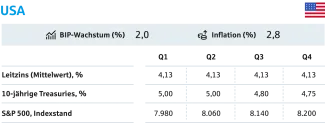
The global economy is expected to maintain roughly the same pace in 2027 as in the previous year. Both Germany and the euro zone are expected to grow by 1.4 %. China is expected to act as a dampening factor, with its economic output likely to lose momentum relative to 2026 and to grow by just 4 %. We expect the US economy to grow by ap proximately 2 %, at a similar rate to the previous year.
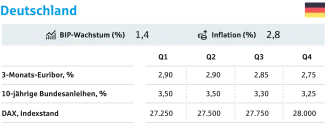
While inflation in China remains low, many industrialised countries are struggling with high inflation. In Germany, the euro zone and the US, the rise in consumer prices will average 2.8 % – above the central banks' targets – but the year on-year rate will fall significantly over the course of the year.
Monetary policy is likely to have been sufficiently recalibrated in both the euro zone and the US in 2026. The ECB and the Fed are then expected to adopt a wait-and-see approach to gauge the impact of slightly more restrictive financing conditions. There will likely be no room for interest rate cuts until 2028.
Selected forecasts for 2027
 Quelle: Helaba
 Quelle: Helaba
 Quelle: Helaba
Despite the price fall in 2026, the outlook for bonds is not that bad. Central banks are not tightening monetary policy any further, which is boosting investor confidence. However, the continued significant rise in the supply of govern ment bonds is preventing a sharper fall in yields. By the end of the year, 10-year German government bonds are ex pected to trade at around 3.25 %, while their US counterparts were trading at 4.75 %.
The positive effects of a funded pension component and AI-driven productivity improvements are likely to materialise only gradually over the medium term. Nevertheless, supported by a cyclical upswing in global economic activity, we expect global equities to deliver returns broadly in line with historical averages despite already high valuations in some market segments. We forecast the DAX to end 2027 at around 28,000 points.
The recovery in the German real estate market remains fragile and differentiation based on property quality and loca tion continues. Higher interest rates reduce the relative attractiveness of commercial property, whose prices are likely to decrease slightly in 2027. However, the growing German economy is stabilising demand. Residential property re mains in short supply, particularly in urban areas, which is pushing up prices. Nevertheless, as affordability deterio rates, the upside potential is limited.
By 2027, gold will recover from the interest rate shock. As opportunity costs fall and fiscal risks rise, investors will in creasingly turn to gold, pushing the price above USD 5,000 in the second half of the year.
The sharp appreciation of the US dollar will come to an end in 2027. The gradual decline in oil prices is negatively im pacting the greenback, as the US is a net oil exporter. Furthermore, Trump’s erratic policies continue to undermine confidence and consequently demand for the dollar. However, capital inflows into the US, driven by the AI boom, re main a supportive factor. Therefore, the euro-dollar exchange rate will rise moderately to 1.15.

-
-
Im Weltwirtschaftslabor flackern die Bunsenbrenner, geopolitische Schwaden trüben die Sicht, und dennoch hält sich das große Experiment erstaunlich stabil.
-
- 20 Negativszenario: Laborunfall
- 70 Basisszenario: Eifriges Experimentieren
- 10 Positivszenario: Die goldene Formel
Eintrittswahrscheinlichkeit der Szenarien
Note: All images of the lab scenarios were generated using AI.