High-speed broadband for everyone
Households and businesses, institutions such as schools and hospitals, and public authorities all have one thing in common: they need fast and reliably available internet. In Germany, this has often not been the case, particularly in rural areas. Over the coming years, the fibre-optic infrastructure is set to be expanded nationwide – partly with the help of funding from Helaba.
From copper cable to fibre optics
When, at the height of the coronavirus pandemic, suddenly more people than ever before had to work from home on their computers whilst also enabling their children to follow home-schooling lessons online, the problem became even more apparent than before: The internet in Germany is too slow. In rural areas in particular, people still mostly receive their data via copper cables, which only allow for a bandwidth of up to 50 Mbit/s.
At the same time as this lack of infrastructure, however, the demand for fast internet is growing immensely: manufacturing companies are turning to the Industrial Internet of Things, public administrations are becoming more digital, the economy needs high data rates, and in leisure time, streaming and online gaming are becoming increasingly widespread. The solution is said to lie in the expansion of fibre-optic networks. Whilst other countries switched to the ‘information superhighway’ some time ago, in Germany barely a quarter of the approximately 50 million households and businesses currently have access to fibre-optic broadband. This means that, at the very least, the cables are already laid underground. However, only 3.4 million households and businesses actually have a connection. This is currently changing: across the country, corporations and joint ventures are competing with one another to expand the networks. By 2030, the whole of Germany is set to be connected. According to the plan, the internet will then run at speeds of up to 1,000 Mbit/s for everyone – more than ten times as fast as it is today.
1,500,000
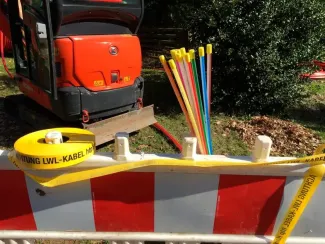
The Glasfaser Nordwest project, financed by Helaba
, provides services to households and businesses.
1,000
Mbit/s data rate for all households and businesses in Germany. That is the target for 2030.
Expansion with structure
Helaba is helping to finance a whole range of these projects – as of April 2023, it has contributed to financing schemes that are helping to provide more than ten million people with fibre-optic connectivity. For the Landesbank, the structure of the project is crucial to its decision to provide funding. “We rely on experienced partners who bring the necessary knowledge and experience with such projects,” says Markus Greif. He is Deputy Director of Project Finance at Helaba. From the department’s perspective, the companies carrying out the roll-out need to have a sufficient credit rating – and the project must also be able to withstand risks. “If something were to go off-plan during the roll-out, the project must not be so thinly financed that it would immediately go into insolvency,” explains Greif. There have been cases of smaller fibre-optic operators who were unable to continue their work because they failed to overcome certain challenges, such as rising construction costs or lengthy approval procedures.
A positive example with favourable framework conditions can be found in Bochum. There, Telekom is rolling out the network in collaboration with Glasfaser Ruhr – a wholly-owned subsidiary of Stadtwerke Bochum. 134,000 households and businesses in the city will be able to benefit from the fibre-optic network there, says Markus Greif, who completed a banking apprenticeship at a savings bank and has been working at Helaba for 15 years. The total investment, into which Helaba has also incorporated KfW funds, amounts to around 180 million euros.
The roll-out of fibre-optic networks, for example, is an important location factor for start-ups involved in the energy transition.
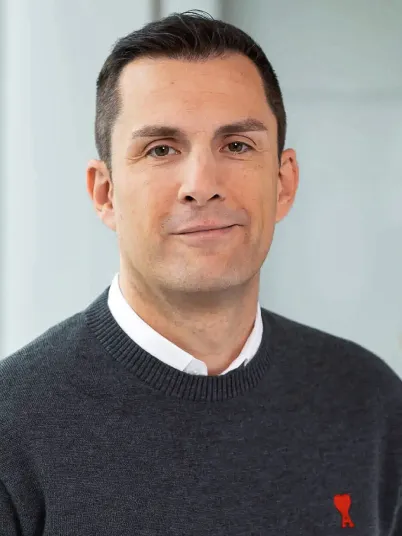
Benjamin Bürkner
Helaba Group Head of Strategy and Digitalisation
Focus on rural areas
However, urban projects such as those in Bochum are less frequently the focus of Helaba’s attention. Competition is often fierce, and in some cases several providers are laying cables at the same time. This situation, which appears rather illogical from the outside, arises because companies undercut one another in the competition for cable routes that are significantly shorter in towns and cities. This results in many individual projects with smaller investment volumes. Helaba therefore prefers to focus on rural areas. For example, it is co-funding a project by Glasfaser Nordwest, a joint venture between the energy producer EWE and Telekom. Put simply, it covers the area between Bremerhaven in the north, Paderborn in the south, the Dutch border in the west and Hamburg in the east. “Glasfaser Nordwest is, in small construction phases, more or less laying a complete network in the cities, towns, residential areas and to businesses. In total, the aim is to potentially connect 1.5 million households and businesses there,” says Markus Greif. The figure itself is impressive, but he makes it clear that it is not about the scale of the projects, adding: “We have also co-financed 25,000 or 30,000 connections before; we simply always analyse each case individually.”
Benjamin Bürkner also considers this provision of connectivity – particularly in rural regions, which have so far tended to be left behind when it comes to high-speed internet – to be extremely important. As Helaba’s Group Head of Strategy and Digitalisation, he aims to support the transition to a digital and sustainable society – for him, the two factors go hand in hand. “The roll-out of fibre-optic networks, for example, is an important location factor for start-ups,” says Bürkner.
If Germany wishes to remain competitive and continue on its path towards becoming a knowledge-based society, the infrastructure must be in place. This also applies to the industrial Internet of Things and to innovative business models. Funding such projects contributes to the United Nations’ Sustainable Development Goals, which promote resilient infrastructure and inclusive and sustainable industrialisation. “In doing so, we are also facilitating social participation and equal opportunities, which should not depend on whether one lives in an urban or rural area,” says Benjamin Bürkner.
The economic aspect
As well as the importance of expanding the digital infrastructure, the key economic figures are crucial for Helaba. The Landesbank generates revenue from the fees incurred when structuring loans and from the interest paid on them. “It’s about, for example, how much a project can borrow and when and how it can repay it, or which financial ratios must be met. The amount of equity capital also plays a role,” says Markus Greif, who handles the financing arrangements together with three colleagues. The risk to Helaba is regularly assessed, as the experts monitor the project closely. “The clients provide us with reports on how the expansion of the fibre-optic network is progressing and what challenges they face.” This monitoring is carried out by a dedicated department within Helaba.
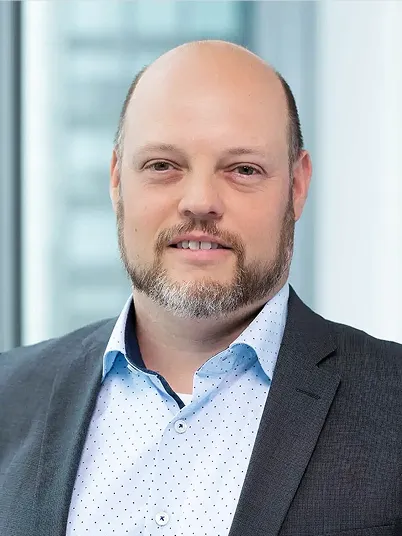
Together with Helaba, we are helping to make Germany a more digital and sustainable place for the future.
Markus Greif
Deputy Director of Project Finance at Helaba
Cables are just the start
A functioning digital infrastructure also includes data centres and mobile phone masts. Helaba is already running a whole range of projects relating to the latter, for example in Germany and France. “This isn’t about individual retail customers using a fibre-optic line at a later date, but about the major network providers – Telekom, Vodafone, O2 and 1+1 – renting the masts,” says Greif. The risk must therefore be assessed quite differently. The four major companies usually share the mobile phone masts under long-term contracts with reliable rental payments. Furthermore, the companies have a strong interest in expanding the fibre-optic network because this will also improve mobile communications. Mobile signals are transmitted from the smartphone to the tower, from there via the fibre-optic cable to the data centres, and back again via the same route.
With data centres, on the other hand, there are no synergies and analysing the projects is more complex. “There are models where the future customers are companies with strong credit ratings, but there are also centres that serve many small providers,” says Markus Greif. “That’s why we need to look closely at the tenant risk, how easily contracts can be terminated, how high the demand is and what the competitive landscape looks like.” For the project financier, all investments in digital infrastructure are important, says Greif, particularly as synergies often arise. “Together with Helaba, we’re helping to position Germany as a more digital and sustainable location for the future.”