
Negative Scenario: Ladoratory Accident
In the baseline scenario, there is a lot of experimentation, but the result is quite impressive. However, handling sometimes highly explosive substances carries risks. The smallest mistakes can have painful consequences in such a situation. Even if everyone is working on the same experiment in 2027, which is by no means a certainty, the goals of the actors are often different or contradictory. This quickly results in a recipe for the big bang.

Given the high level of uncertainty and multiple risk factors, many observers consider a more or less spectacular laboratory accident in 2027 to be the most plausible scenario: if so many things can go wrong, something will go wrong! In fact, a toxic mix of political decisions and negative market developments that will push the global economy into recession is a serious scenario for 2027, even if, in our view, it is not the most likely one.
Two things are infinite, the universe and human stupidity, but I'm not quite sure about the universe yet.
Albert Einstein
attributed to
The reactants and catalysts that will be used globally in 2027 are to a large extent highly volatile. This starts with the geopolitical situation, where it is obvious that even the supply of a little energy at the wrong time or in the wrong place can lead to an explosion like the Iran conflict in spring 2026. In addition to the well-known existing and potential trouble spots such as Ukraine, Iran, Taiwan or North Korea, others have recently been added. For example, the threat of a Russian attack on NATO is being discussed more seriously than was conceivable just a short time ago. Additional shocks to the energy markets and to the global flows of goods are possible at any time.
AI: Smouldering fire instead of beacon?
The AI industry, so far a pillar of the global economy, also represents a risk. For example, the "tech bros" at the top of AI companies in the US sometimes seem to act with the ethical integrity of Doctor Frankenstein. As for the new technologies, however, extreme scenarios do not have to occur to hit the global economy hard. Even a sustained disappointment regarding expected productivity increases and corporate profits could trigger significant spending and price corrections. If the AI boom in investment were to abruptly stop, it is unclear what could close the resulting demand gap.
High debt poses potential dangers
CDS* 10-years goverment bonds, basis points
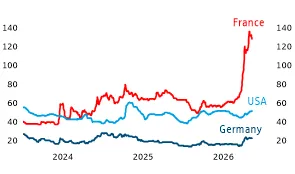 * Credit default swaps, Sources: LSEG, Helaba Research
Another experimental setup that does not inspire much confidence can be found in the area of public finances. In view of the lack of a credible strategy for deficit reduction in the US and the increasing economic policy paralysis of a major EU state such as France, the occupational health and safety group responsible for the global economic laboratory may well break out in a cold sweat.
Finally, there is the US president, whose unpredictability is unlikely to be significantly altered by the midterm elections, and who already in the first half of his second term in office repeatedly acted like a clichéd "mad scientist": his goals (almost too) firmly in sight, but unpredictable and ruthless in the timing and dosage of his policy experimentation. This is especially true of the relationship between the US and China, where a continuation of the trade truce is anything but a foregone conclusion.
Overview of forecasts in a negative scenario
In the negative scenario, the global economy slips into recession due to a series of negative shocks. In Germany and the euro zone, the economy weakens significantly, causing gross domestic product to shrink by around 2 %. The economy in Europe will take several years to fully recover from this recession. The US economy shrinks less sharply, but unemployment also rises significantly there.
Even though the effects of geopolitical shocks initially cause many prices to rise sharply, weak demand quickly dampens inflation, which quickly falls below the rates in the baseline scenario. In Germany and the euro zone, the inflation rate will average 1.5 % for the year in 2027 and will remain below the ECB's target of 2 % in 2028. In the US, lower energy prices will have a stronger impact – here, inflation will fall below 1 % in 2027.
A weak economy and soon falling inflation rates are calling monetary policy into action. In this context, the ECB and the Fed cut key interest rates to below the 2 % mark. However, a renewed experiment with zero or negative interest rates is not a serious option for the central banks, as the experience gained has ultimately been problematic. Depending on the development of risk premiums in the euro zone, on the other hand, the purchase of government bonds is likely to be used as a supportive measure by the ECB.
The bond market is seeing strong price gains, at least for bonds that serve as safe havens. Falling key interest rates are driving yields on 10-year German government bonds down to around 2%, while 10-year U.S. Treasuries are reaching the 3% mark. However, yield curves are not inverting. Risk premiums are trending higher as a result of significantly rising government deficits due to the crisis.
Given already stretched valuations, equities remain vulnerable to setbacks. Negative shocks related to geopolitics, trade policy, economic growth, or the monetisation of artificial intelligence could result in a significant earnings slowdown. At the same time, investors may become less willing to pay premium valuation multiples, leading to a broad-based derating of equity markets. Under such circumstances, equities would likely enter a bear market, with the DAX temporarily retreating towards 17,000 points.
On the German real estate market, the already fragile recovery ends abruptly and prices fall again. Residential real estate is experiencing only moderate price declines due to persistent shortages. In contrast, office and retail properties are losing significant value in the weak economic environment. Even falling financing costs cannot prevent the drawdown.
The price of gold is exploding. The precious metal can make strong gains as the usual safe-haven competitors like bonds react with a risk discount. Gold is likely to benefit, in particular from increasing fiscal pressure, allowing the precious metal to form a new record high of over 6,000 US dollars per troy ounce.
The US dollar lives up to its reputation as a safe haven and appreciates against the euro. However, since geopolitical risks have already weighed on the euro in the previous year, the additional appreciation potential of the dollar is limited. In addition, uncertainties surrounding politics under US President Trump are slowing down the inflow into the dollar. The exchange rate movement is thus weaker than in past crisis episodes. The euro-dollar exchange rate falls to 1.00 by the end of the year.

-
-
In the global economy laboratory, the Bunsen burners flicker, geopolitical mists cloud the view, and yet the grand experiment remains remarkably stable.
-
- 20 Negative Scenario: Laboratory Accident
- 70 Baseline scenario: Eager Experimentation
- 10 Positive Scenario: the golden forlmula
Probability of a scenario occurring

Note: All images of the laboratory scenarios have been generated using AI.