
Interview: How WIBank is embedding and further developing ESG considerations in practice

Three questions for Alexandra Böhne
Alexandra Böhne, ESG Co-ordinator at WIBank, explains in an interview how a culture of networking at WIBank can help to implement ESG initiatives.
Our ESG network brings together experts from all departments of our development bank. Their role is to promote ESG issues within the organisation and to relay questions, ideas and proposed solutions from the departments back to the network. For this cross-functional role, we draw on this specialist knowledge to further develop our development finance products and processes with a view to the future.
A regular exchange of best practices is just as important as close collaboration with Helaba’s ESG experts, who provide us with additional perspectives and methodological insights.
As a development bank, we have been systematically addressing sustainability issues for many years. This topic has gained further momentum as a result of public debate and the ever-increasing regulatory requirements, which have been defined in particular by the European Union’s Green Deal.
A key milestone was the implementation of sustainable finance projects in recent years. These served to embed the complex regulatory ESG requirements into our development bank’s processes and to initiate the gradual establishment of an ESG data structure.
To ensure the ongoing development of these initiatives, we have established a cross-departmental ESG multiplier network. This ensures that subject-specific sustainability issues continue to be discussed and operationally integrated within the individual departments even after formal projects have been completed.
Through our ESG projects, we have further advanced the systematic integration of ESG criteria. As this is an ongoing process, the next step is to link these aspects even more closely to our business strategy.&
A key task in this regard is the gradual improvement and standardisation of our ESG data structure in order to reliably meet the increasing regulatory disclosure requirements.
Voices from within the organisation
The following statements illustrate, by way of example, how ESG criteria are integrated into the individual departments and implemented in practice:
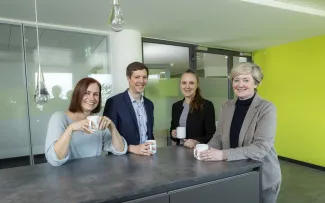 Stefanie Knapp, Arne Wartini, Christine Bachmann und Alexandra Böhne
WIBank supports the financing projects of its customers in Hesse. As the development bank of the State of Hesse, it is therefore the central point of contact for private individuals, businesses, self-employed professionals, local authorities and districts. Through its funding programmes, it supports projects that contribute to the long-term development and resilience of the economy, local communities and society.
The funding programmes cover a broad spectrum: from measures to improve energy efficiency and protect the environment and resources, through support for the economic development of Hessian businesses and infrastructure projects, to the promotion of education, skills training and social housing. In this way, WIBank contributes to the sustainable development of the state of Hesse.